


A prompt that writes a brilliant email can produce a terrible piece of research.
That is not because the AI suddenly got worse. It is because writing and research are different jobs. One asks the AI to create something. The other asks it to find evidence. They need different instructions, and they fail in different ways.
Most beginners use the same style of request for everything. This guide shows you how to match the prompt to the job.
First, decide which job you need
Almost everything you ask an AI assistant falls into one of five jobs:
Write: create text for you.
Research: find and weigh evidence.
Teach: help you understand something.
Plan: organise time, tasks or decisions.
Calculate: work with numbers.
Naming the job takes two seconds and changes what you put in the prompt.
To show the difference, we ran one test with Claude on the free plan. The situation continues from our previous guide, How to Prompt AI: A Beginner’s Guide to Better Answers, where we accepted a job offer as a junior graphic designer. Now it is time to start. Five tasks, five fresh chats, five different prompts.
Job 1: Write
What to include: who will read it, what it should achieve, the tone, and a length limit. Asking for two versions gives you a real choice instead of one take.
I start a new job as a junior graphic designer at a small design studio on Monday. Write a short hello message I can post in the team chat on my first morning.

The team is about 12 people and the culture seems relaxed and friendly. I want to sound warm and genuine, not overexcited. Mention that I’m looking forward to learning how everyone works.

Keep it under 60 words. Give me two versions: one slightly more formal, one more casual.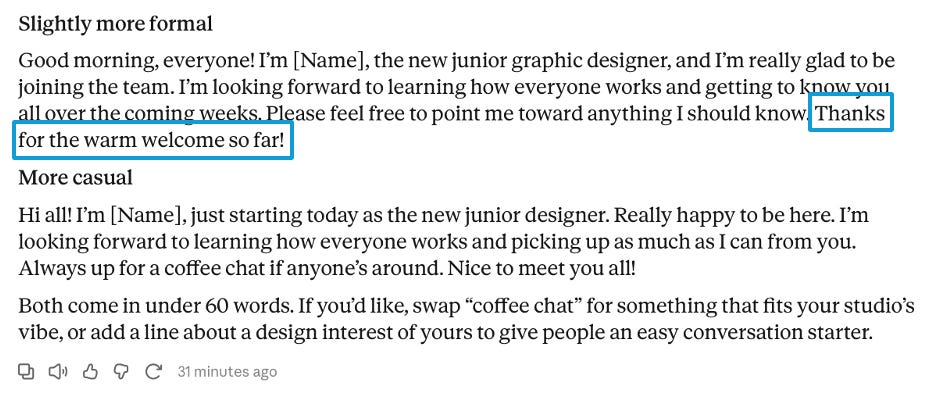
Two clear versions. Look at the last line of the formal one before you post it.
What happened: two genuinely different messages, both under the limit. Claude even suggested swapping a phrase to fit the studio’s style.
What to check: read it as if you were the one hitting send. The formal version ends with “Thanks for the warm welcome so far!”, in a message meant for your first morning, before anyone has welcomed you. Perfectly written, slightly wrong moment. AI writing often sounds right while saying something you wouldn’t say.
Job 2: Research
What to include: a precise question, an instruction to search the web, and a demand to name each source and say how strong it is. Without that last part, a blog post and a scientific study can look equally convincing.
Search the web: what does current research say about the most common reasons new employees struggle in their first 90 days at a new job?

Give me the three most supported reasons. For each one, name the source and say whether it is a study, a survey or an opinion article. If the evidence is weak or mostly opinion, say so clearly.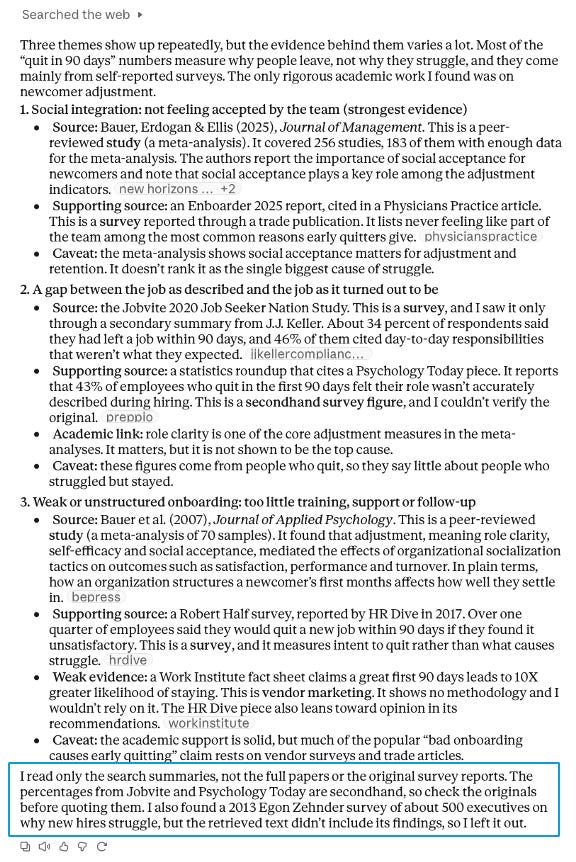
Every source labelled, weak evidence flagged, and an honest note about what Claude did not read.
What happened: Claude searched the web and returned three themes. It labelled each source as a peer reviewed study, a survey or, in one case, vendor marketing with no visible methodology, which it said it would not rely on. It also pointed out that most of the popular statistics come from people who quit, so they say little about people who struggled but stayed.
Then came the most useful part. Claude admitted it had read only search summaries, not the full papers, and that some percentages were secondhand.
What to check: treat the answer as a map, not a conclusion. It tells you where the evidence is and how strong it looks. Before you quote anything, open the original source. We are deliberately not repeating Claude’s findings here as facts, because we haven’t read the original papers either. That is the whole point.
Job 3: Teach
What to include: what you already know, what you want to understand, and a request to test you. Clear explanations feel like understanding. Questions prove whether it is.
My new manager keeps mentioning OKRs and I don’t know what they are. I have never worked in a company that uses them.

Explain OKRs in plain English using one simple example from a design studio. Then ask me three short questions to check I understood. Ask them one at a time and wait for my answer before giving feedback.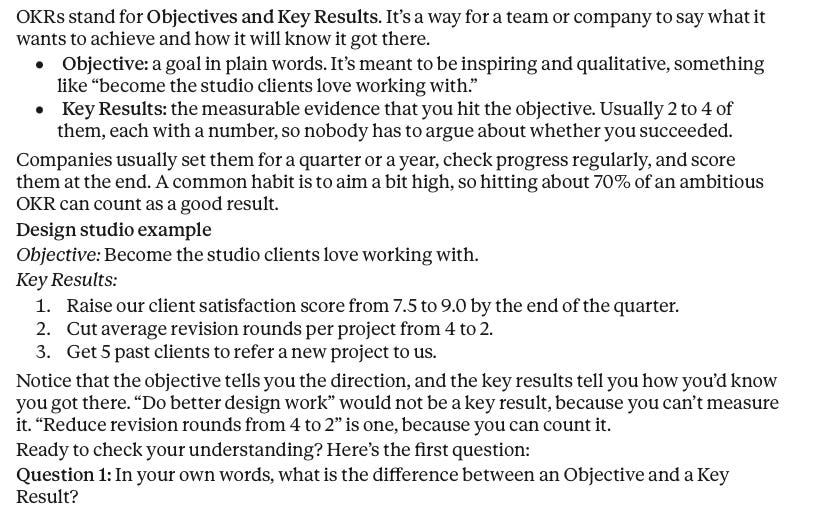
A plain English explanation with a concrete example, then the first check.
What happened: Claude explained OKRs (Objectives and Key Results) with a design studio example, then asked one question at a time, as instructed. To test it, we answered the last question wrongly on purpose, offering “write 5 blog posts” as a key result for launching a website.
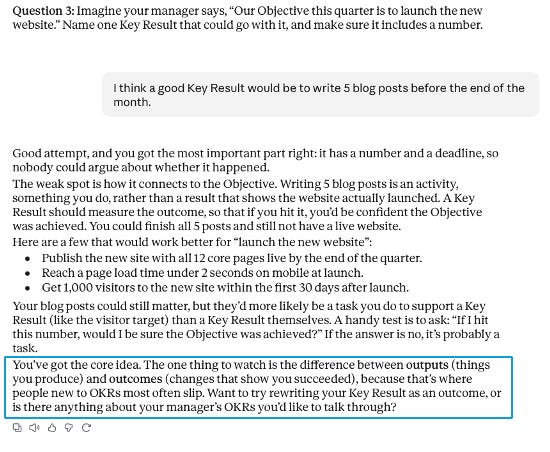
A wrong answer, corrected without making the learner feel stupid.
Claude started with what was right (the answer had a number and a deadline), then explained what was wrong: writing blog posts is an activity, not proof the website launched. It gave better examples and a simple test to use next time.
What to check: whether you can apply the idea, not just repeat it. If you can’t answer the questions, ask for another example rather than reading the explanation again.
Job 4: Plan
What to include: the goal, the deadline, your real constraints and what you want to protect. Then ask what is most likely to go wrong. A plan without a risk check is a wish list.
Help me plan my first 30 days at a new job as a junior graphic designer.

My goals: meet each of the 6 people I’ll work with most, learn the studio’s design tools and file system, and deliver my first small project by the end of week 3.

Constraints: I’m in the office 3 days a week and work from home 2 days. I don’t want to overload my first week.

Give me a simple week by week plan. Then tell me which part of the plan is most likely to go wrong, and why.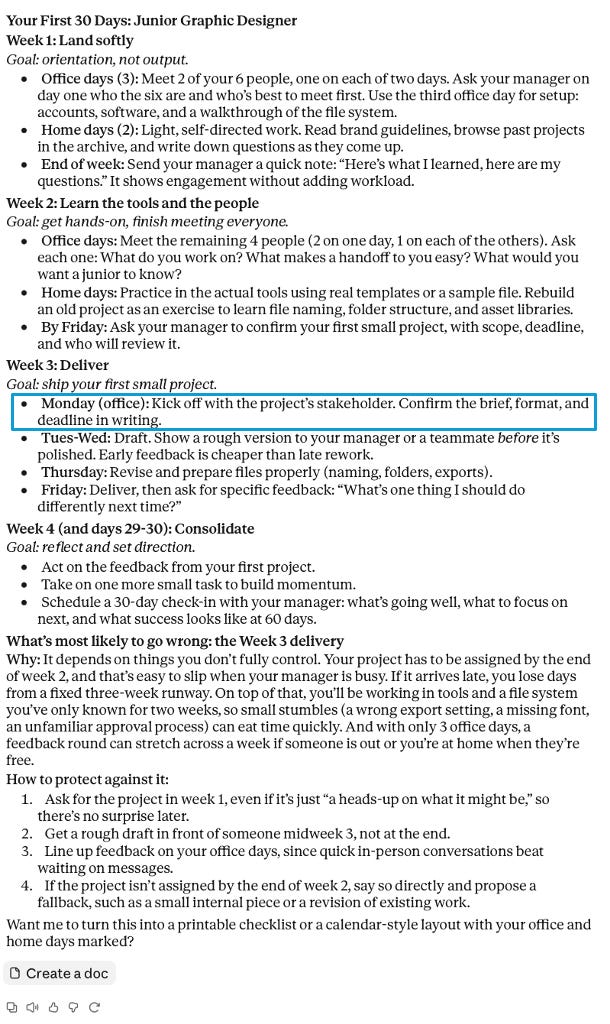
A sensible plan with a clear risk analysis, and one assumption hidden in week 3.
What happened: a realistic four week plan that kept the first week light, plus a sharp answer to the risk question: the week 3 deadline depends on the project being assigned on time, which you don’t control. Claude suggested asking for a preview of the project in week 1.
What to check: the assumptions inside the plan. Claude scheduled the project kickoff on “Monday (office)”, but we never said which days were office days. Plans look finished long before they fit your actual calendar. Read every day and time against reality.
Job 5: Calculate
What to include: all the numbers, the exact rules for using them, and a request to show the working. If you can’t see the steps, you can’t check them.
I need to choose how to commute to my new job. I go to the office 3 days a week. Use 4.3 weeks per month.

Bus: 45 minutes each way, monthly pass costs 40 euros.
Bike: 30 minutes each way, about 10 euros a month for maintenance.
Car: 20 minutes each way, 90 euros a month for fuel plus 60 euros for parking.

Calculate the total monthly travel time in hours and the monthly cost for each option. Show your working in a table. Then tell me which option is best value if I value my time at 12 euros an hour. List any assumptions you made.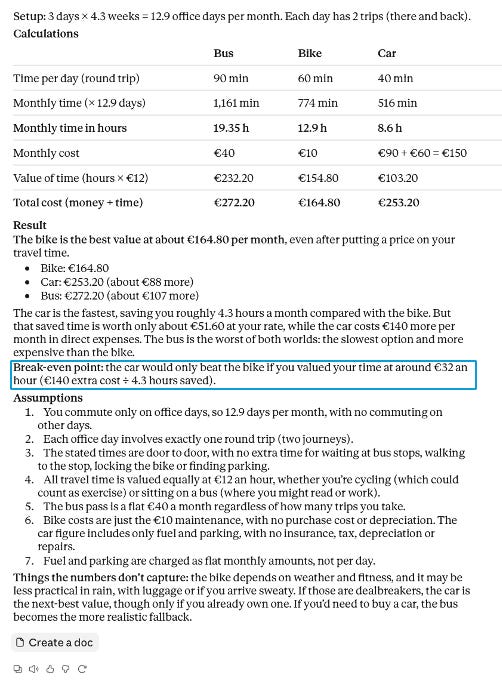
Every step visible, so every number can be checked.
What happened: we checked every number by hand, and the main table was correct: the bike came out as the best value at 164.80 euros a month once time was priced in. Claude also listed seven assumptions, such as ignoring the cost of buying a bike, and noted what numbers can’t capture, like rain.
What to check: the numbers you didn’t ask for. Claude added a break even point, saying the car would only win if your time were worth “around 32 euros” an hour. The exact figure is 140 divided by 4.3, which is 32.56. A small rounding, and harmless here. But in a budget or a quote, extra figures deserve the same check as the main ones.
Your five job cheat sheet
Write: give audience, purpose, tone and length. Check that it sounds like you and fits the moment.
Research: ask for sources and how strong each one is. Check the originals before you repeat anything.
Teach: say what you know and ask to be tested. Check that you can apply it, not just repeat it.
Plan: give goals, constraints and priorities, and ask what could go wrong. Check every assumption against your real calendar.
Calculate: give all the data and ask to see the working. Check every number, including the extras.
What all five have in common
In every task, the most useful part of the prompt was the instruction that made checking easier: two versions to compare, labelled sources, questions to answer, a risk to look for, working to follow.
The best prompts don’t just ask for an answer. They ask for an answer you can verify.
Try it today
Pick one real task from your week. Before you write the prompt, name the job: write, research, teach, plan or calculate. Then use the matching line from the cheat sheet and see how the answer changes.
Your next step
New to Claude? Start with Claude for Complete Beginners: Your First 15 Minutes.
Next comes How to Use Claude: From Beginner to Confident Power User, where we go beyond single chats into the features that make longer projects easier.
If this guide helped, save it for the next time an AI answer disappoints you, and share it with someone who uses AI for everything in exactly the same way. Reply and tell us which of the five jobs you use most.
Last checked: 1 November 2026, using the Claude free plan on the web.