

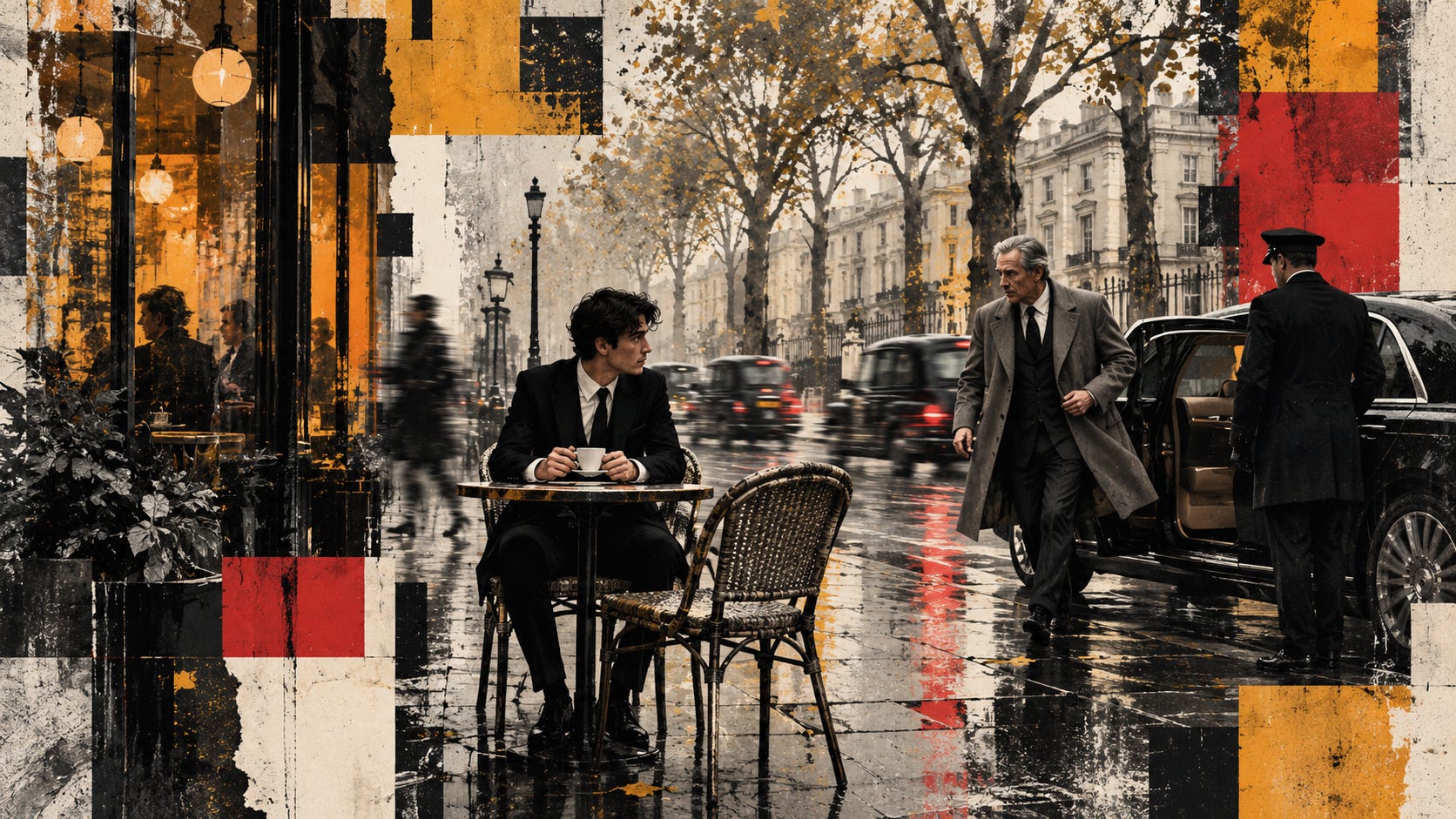
Cedric got the seat at twenty past nine.
Most mornings he did not. Most mornings he stood against the wall outside Fenn’s with a takeaway cup, beside the people who had somewhere to be, and watched the people who did not. Two men in suits discussing a deal in voices meant to be overheard. Three builders arguing about last night’s match. A woman reading a paperback with her shoes off under the table. For this he left home half an hour early, six days a week, and most mornings the half hour bought him a wall.
Today it bought him a chair.
He did not take out his phone. He sat with both hands round the cup and listened. The traffic easing round the square. The birds in the plane trees across Berkeley Square. Saucers. Spoons. Pieces of other people’s lives from the tables on either side. Twenty minutes of being a customer. Then the staff entrance at half past nine, and the restaurant until midnight.
At twenty five past, the car arrived.
A long black Bentley, as most mornings. It drew up at the kerb and the driver came round to open the rear door, and for a moment, even from his chair, Cedric could smell the leather.
‘Shall I bring your coffee to the car, Mr Murphy?’
‘No, Adam. I’ll have it here this morning. You go. I’ll walk to the office.’
The man stepped onto the pavement and looked along the tables. Grey coat, no tie, the kind of shoes that never touched rain. There was one empty chair at Fenn’s, and it was at Cedric’s table.
‘May I sit here, young man?’
Cedric’s mouth would not work for a second.
‘Of course, sir. Would you like me to move? You can have the table.’
The man smiled. ‘You don’t have to move. We’ll share it. Nobody should be standing.’
The waiter came, and Mr Murphy ordered a black Americano. Cedric looked at the car pulling away into the traffic and heard himself speak before he had decided to.
‘You have a beautiful car, sir. I see it almost every morning. I always imagine what it would be like to drive it.’
‘So do I,’ said Mr Murphy.
‘But you have a driver. Wouldn’t you rather drive it yourself?’
‘Every morning.’
They both laughed, and that made the next thing easier to say.
‘I’ve seen you a few times at the restaurant where I work, sir. You’re always with a group, always talking about work. You always order the same steak.’ He hesitated. ‘And you always leave half.’
Mr Murphy looked down at his coffee for a moment.
‘Do I,’ he said. It was not a question.
Then he looked up again, and something in his face had moved into place. ‘The first floor. By the orchids.’
‘The Orchid Room, sir. That’s what we call it. It’s mostly for VIPs. Celebrities. Special occasions.’
‘And men who talk about work.’
‘I served you once.’
‘Yes,’ said Mr Murphy slowly. ‘Now I remember you.’ He turned his cup a quarter turn on its saucer. ‘What are you doing out so early, son?’
‘Double shift, sir. I start at half nine. I like a bit of air before I go in.’
‘Until when?’
‘Midnight. An hour off between five and six, then back.’
Mr Murphy nodded as if he had been told the price of something.
‘And you, sir,’ Cedric said. ‘You must own something big around here. Sorry. I shouldn’t ask.’
‘Don’t be sorry. Something around here. A few things further down. A few in other countries.’
‘How do you look after all of them? Isn’t it hard?’
‘I don’t look after them. Other people do. My job is choosing the people.’ He drank. ‘Do you like it? The restaurant?’
‘I’m proud of it, sir. Working there is nearly everything I wanted. One day I’d like to be one of the managers.’
‘You will.’ Mr Murphy said it plainly, the way people say the time. ‘If you could change one thing about the place, what would it be?’
Cedric thought about it properly, because the question deserved it.
‘The entrance. It’s too narrow. Guests queue at the front desk in their coats, and the first thing they feel is squeezed.’
Mr Murphy said nothing to that. He only looked at Cedric a moment longer than a stranger would.
At nine twenty eight Cedric stood. ‘I have to go, sir. Thank you for the company. Sorry if I talked too much.’
Mr Murphy raised a hand for the waiter and paid for both coffees before Cedric could reach his pocket.
‘Thank you, sir. I hope I see you again.’ At the edge of the pavement he turned back. ‘And next time, if I’m not on, try the king crab with the noodles. It’s new on the menu.’
They smiled at each other and walked away in opposite directions.
⁂
By ten the restaurant was coming back to life. Chairs came down off the tables. Cloths went on. Plates and cutlery were laid half a centimetre from the edge, every setting in a line you could have drawn with a ruler, and the sommelier held each glass up to the window before it was allowed near a table.
At ten, as every morning, the florist arrived.
She worked until half past eleven, table by table, setting purple and white orchids into handmade vases, each stem trimmed to the same height. Cedric watched her place a flower, step back, step forward, take it out and replace it with one from her box that looked exactly the same. Then step back again.
‘Sorry to ask, madam,’ he said.
‘Emy. Call me Emy. Nobody calls me madam.’
‘Emy. I’m Cedric. I was just wondering. They’re all the same, aren’t they? Why do you keep changing them?’
She did not stop working.
‘People come here for the food, Cedric. The service. The wine. But they also come for the room, and the room is all about perfection. Your managers walk the floor after me. I don’t want anyone to find one flower that’s bruised, or taller, or shorter. From the first table to the last, they’re all the same size, all in the same place, four fingers from the left edge.’ She glanced at him. ‘When you set the tables, I suppose they told you four fingers too.’
‘No,’ said Cedric. He took a small wooden measure out of his pocket. ‘We use this. So we don’t miss even a millimetre.’
Emy looked at the wooden measure for a long moment. Then she laughed once, quietly, and went back to her flowers.
‘You see,’ she said. ‘Details. Now let me focus.’
At the pass, collecting forks, he watched the head chef lift each piece of fish to his nose before he would accept it, and a commis cutting asparagus into lengths so identical they might have come out of a machine. Nobody spoke. Nobody needed to.
The manager found him there.
‘Busy lunch, Cedric. You’re on section five. And keep an eye on the new boy while he takes orders.’
That evening, at the briefing before dinner, the manager read the reservations, the specials and the allergies, and then, as if it were another item on the list, he said that Cedric was promoted to supervisor, starting tomorrow.
Cedric stood very still. Nobody had told him. Nobody had even hinted.
The next day he wore a darker uniform. Black suit, white shirt, black tie, shoes polished until the floor showed in them. He could not wait to walk the room.
⁂
A few days later he was late to Fenn’s, and Mr Murphy was already there.
The car was parked across the street with Adam waiting beside it. Another man sat at Mr Murphy’s table, someone Cedric did not know, papers between them.
‘Good morning, Mr Murphy.’
‘Cedric. Get your coffee and sit down.’
‘I’m all right, sir. I’m due in soon.’
‘Then I’ll see you tonight. I have a table at yours. Eight o’clock.’
At the evening briefing the manager read the book and stopped at one line.
‘Mr Murphy. Dinner for eight in the Orchid Room. Business meeting, so music down. Water on ice before they arrive. A short speech when they sit, drinks, and dinner at nine sharp, three courses.’ He looked up. ‘He’s asked for Cedric to look after them.’
Marco, across the room, raised an eyebrow. The manager held Cedric’s eye a second longer than he needed to.
‘By name,’ the manager said.
‘Noted, sir.’
Mr Murphy arrived at eight exactly. Cedric stood at the entrance to the Orchid Room and welcomed each guest, took coats, seated them, poured water, offered the drinks list, served the drinks and stepped back to the wall, close enough to see an empty glass, far enough not to be in the room.
Mr Murphy stood for the speech.
He spoke about a new venture, about risk, about patience. Then he said something that made Cedric’s ears burn.
‘This is an investment, gentlemen. Take this young man here, Cedric. He works for us. We give him the tools he needs, and then we judge him on return. On revenue. On service. It’s the same principle. For me, it’s an investment, and it’s worth going ahead.’
The men laughed politely and looked at Cedric, and then they looked away, because he was furniture again.
Cedric stood at the wall with the water jug and could not stop smiling. He did not know what any of these men did for a living, and Mr Murphy had used him as the example.
At nine the food began.
When Cedric took the orders, seven men chose without looking up from their conversation. Mr Murphy closed the menu and looked straight at him.
‘The king crab. With the noodles.’
Cedric explained each dish as he set it down: the crab from cold northern water, the noodles made by hand in the kitchen that afternoon, the dressing finished at the pass. The others nodded and kept talking. Mr Murphy listened to every word.
When the plates came back, his was the only one that was empty.
After dessert, Mr Murphy caught his eye.
‘Cedric, would you ask your manager to come in? And bring the bill.’
The manager went in with the leather folder and the door closed behind him. A few minutes passed. When he came out, he looked at Cedric in a way Cedric could not read, and then he looked away.
Later, tidying the station, Cedric opened the folder. There was no card slip inside. No signature. He supposed the manager had dealt with it.
At the door Mr Murphy shook his hand.
‘Thank you, Cedric. You were excellent. Everything was perfect.’
‘My pleasure, sir. I hope we see you again soon.’
⁂
At ten past midnight Cedric and Marco walked towards the bus stop on Regent Street, collars up, ties in their pockets.
‘Think about it,’ Cedric said. ‘The biggest we can ever be in this business is managers. And every single night we serve millionaires. What did they do that we didn’t?’
Marco laughed so loudly a man across the road turned round.
‘I don’t think we did anything wrong, mate. Someone has to be the manager.’ He nudged him. ‘And come on. You’d love it. You already act like one.’
The fog had come down over Regent Street, and they disappeared into it together.
⁂
A few weeks later Cedric was at Fenn’s at twenty past nine with his coffee going cold in front of him. He had worked eleven days without a full day off. His shoulders had dropped. His eyes were closing.
The Bentley stopped at the red light on the corner. Then, instead of moving on when the light changed, it pulled across to the kerb in front of the café.
The rear window slid down.
‘Good morning, Cedric. How’s the day treating you?’
Cedric was on his feet before he knew it, shoulders back, voice bright.
‘All good, sir. Just a quick coffee before I go in.’
‘Have a good day, son.’
‘You too, sir.’
Adam smiled at him from the driver’s seat. The window slid up and the car rejoined the traffic.
Cedric sat back down slowly. What a strange thing, he thought. There were so many of them in Mayfair, men like that, and to every one of them he was invisible. Except this one. This one always stopped. He acts as if we’re friends, Cedric thought. He must be lonely. He probably has nobody.
And he eats the king crab now, not the steak.
He put a note under his saucer and stood.
‘John, five pounds there. Keep the change, mate.’
‘Cheers, Cedric. See you tomorrow.’
⁂
On his days off Cedric walked the centre of London looking at restaurants.
Mostly from the outside. The famous ones, the ones with stars, the ones people queued for. He studied how the doors opened, how the hosts stood, what the tables looked like through the glass. Now and then, if there was a terrace, he went in for a coffee or a dessert, because that was what he could afford, and he watched how they did it.
That afternoon he stopped outside a hotel on a quiet street. The whole ground floor was a restaurant, and he was up on his toes at the window, trying to see the far end of the room, when the doorman spoke.
‘All right there?’
‘Yes. Yes, sorry.’ Cedric felt his face go hot. ‘I was just looking to see if there was a table. For one. Only me.’
The doorman opened the door. ‘Ask at the desk.’
He had not meant to go in. But he was too embarrassed not to, and a minute later he was sitting in the middle of the room surrounded by people eating lunch.
‘Just dessert, please. And an English breakfast tea.’
It was nothing like his restaurant. One long bright floor. Staff in white jackets. Low jazz in the background. The service moved like water, nobody hurrying, nothing missed. He sat with his tea and thought, I love where I work. But this. This is just.
A hand landed on his shoulder.
He turned. Mr Murphy.
‘Sir. What a surprise.’
‘Good to see you, son. Are they looking after you? Are you on your own?’
‘Yes, sir. All fine. I come for the desserts. I like going to different places, to see how they do things. To learn.’
‘Good.’ Mr Murphy squeezed his shoulder once. ‘Next time, try the mushroom risotto. It’s the best thing here.’
And he was gone, back across the room, to a table Cedric could not see.
Cedric sat very still. All of London, he thought. Every restaurant in the city, and we are in the same one.
He paid, and left.
⁂
The next evening he arrived for the dinner shift and Clara from housekeeping caught him at the staff door.
‘Mr Paul wants you in his office.’
‘Is everything all right?’
‘How would I know?’ She shrugged. ‘I hope so.’
Mr Paul, the general manager, was on the phone when Cedric knocked. He waved him in.
‘Of course, sir. Tomorrow evening, your usual table, and I’ve noted the anniversary. Have a lovely evening.’ He put the phone down and turned. ‘Cedric. Sit down.’
‘Is everything all right, Mr Paul?’
‘Everything is perfect. We’re opening a new restaurant soon. We’ll need more managers, here and there, and some of ours are moving across.’ He leaned back. ‘We’ve decided you deserve it. From next week you’ll do the management course. Three weeks, weekday mornings, eleven until three. Evenings, back on your shift.’
Cedric heard the words and could not make them mean anything yet.
‘Four years ago you walked in here as a commis,’ Mr Paul said. ‘Now you’ve been selected to run the floor. Study. Be ready. In a few months you’ll be wearing the navy suit.’
‘Thank you. Thank you so much, Mr Paul. I’m sorry. I’m just a bit confused.’
‘Go back to the floor. And don’t tell anyone yet. Let them see you in the suit. Let them be surprised.’
On the floor that night he was everywhere at once. The pass, the section, the new boy, the front desk, the guests arriving in their coats through the narrow entrance. He was tired to his bones and happier than he could remember being.
Just before midnight he found Mr Paul at the bar.
‘I’m in early tomorrow, sir. Time for me to go. Thank you again.’
‘Good night, Cedric. See you tomorrow.’
⁂
In the morning he woke early enough, and at twenty past nine he had a chair at Fenn’s. John brought his coffee without being asked.
The Bentley came round the corner. Cedric straightened his jacket and sat up.
The car stopped. Adam opened the rear door, and Mr Paul stepped out.
Cedric stared. From the other side of the car came Mr Murphy.
‘Good morning, Cedric.’
‘Good morning, Mr Murphy. Good morning, Mr Paul.’
They took the next table. John brought two black Americanos. Mr Murphy did not lower his voice.
‘As I said, Paul. The only thing we change is the entrance. It’s too narrow. Guests queue at the front desk with their coats on, and the first thing they feel is squeezed. Move the desk to the left. The room beside it becomes the cloakroom. And we have the parking now, so we hire valets. Two for each service.’
‘Yes, sir,’ said Mr Paul.
Cedric sat with his cup halfway to his mouth.
Mr Murphy’s phone rang. ‘I have calls, Paul. I’ll find you later.’
Mr Paul picked up his coffee, stood, and sat down at Cedric’s table.
‘Mr Paul,’ Cedric said quietly. ‘Are you leaving us? Are you going to work for Mr Murphy?’
Mr Paul smiled.
‘I already work for Mr Murphy. So do you. He owns the restaurant, Cedric. And the new one.’
Cedric turned. Mr Murphy was on the phone, looking out at the square.
He thought of a car he had imagined driving, and a man who imagined it too. He thought of seven men around a table and the word investment, and how warm it had made him feel. He thought of a window sliding down at a red light. He could not tell any more which of those things had been kindness, and which had been the job.
‘Why did nobody tell me?’ he said.
Mr Paul finished his coffee.
‘Would you have told him about the steak?’
Then he stood. ‘Come on. We’ve a lot to do, Mr Future Manager.’
Cedric left five pounds under his saucer. At the next table Mr Murphy was still on the phone, and did not look up.
They crossed Berkeley Square together under the plane trees, and were gone between the black cabs.