

In Part Three, a knock at the door took away his home, and a manager’s sofa gave him a place to sleep. A promise of a better job turned into the same apron he had worn on his first night in London, and he climbed back up, one year at a time. He sat on a bench in a square and watched the white lines in the sky. And a girl arrived with one suitcase and the same dream he had always carried: to fly. Something began between them. He almost told his parents, and stopped. Too early, he thought.
⁂
Then the world stopped.
It happened in days. The restaurant emptied, then closed. The streets outside went quiet in a way he had never heard in London, not once in all those years: no buses sighing at the stops, no voices, no sirens, only birds, and the wind moving litter along an empty road. On the news every night, the city he loved was a map of red.
For almost a year, there was no work. No end that anyone could see.
For the first time since the morning he came up the steps at Tottenham Court Road, he had nowhere to go.
At first he tried. He cleaned his room. He read. He walked once a day, the one walk they were allowed, through streets with every shutter down. Then the walks got shorter. Then they stopped.
He stopped going anywhere at all.
The days lost their edges. He lay in bed through the mornings and through the afternoons, the curtains closed, the light in the room the same grey at noon as at dusk. He began taking pills to sleep, because sleep was the only place where he did not have to think about the money running out, or the restaurant, or the years, or what any of it had been for. He lost weight. Some days he did not open the curtains at all. He lay there with his eyes closed, and pushed the hours past him one at a time, like a man pushing a heavy door.
The man who had walked into 250 shops in three days could not walk into his own kitchen.
Every few days, he called home. He would sit up for it, and clear his throat, and make his voice ready.
‘Are you ok? Are you staying inside? Is Dad ok? Are you being careful?’
They were fine. They were careful. It was him they were worried about, alone in a city that was on their television every night.
‘All ok here,’ he said. ‘I’m fine. I’m resting. Don’t worry about me.’
When the call was over, he lay back down with the phone on his chest. And one night, in the dark, he typed the truth.
Mum I’m not ok. I don’t get out of bed. I don’t eat. I don’t
He could not finish it.
It was the hardest message he had ever written, harder than the CVs, harder than the chef, harder than the sofa. And he could not send it. He could not even finish the sentence.
He held down the key, and watched it go, letter by letter, and lay there in the dark with the empty screen glowing on the ceiling.
She was the one who noticed.
She noticed the plates that came back from his room untouched, and the curtains that stayed closed, and the way he answered the door to her as if it took everything he had. She did not make a speech about it. She did not ask him what was wrong, because she could see what was wrong.
She brought him food, and sat on the end of the bed, and stayed until he ate it. In the mornings she knocked, and opened the curtains, and let the grey London light fall across the floor whether he wanted it or not. On the days he could not speak, she sat with him in the quiet and did not ask him to. On the better days she made him walk with her, just to the end of the street and back, then to the corner, then a little further.
She had come to this city with one suitcase, as he had. She knew what it was to be alone in it.
Slowly, without either of them ever saying the word, she carried him through.
When the restaurants opened again, nothing was the same. He went back. He put on the suit and stood on the floor and did the work, and did it well, because he did not know how to do it any other way. But something in him was tired in a way that sleep did not fix. The city he had fought so hard for looked different to him now. Smaller, somehow. Or perhaps he was bigger than it, and had not noticed.
She found other work, in a bakery, and still she stayed in the house in the south. And somewhere in that strange year, what had been growing between them over tea in a kitchen at midnight became something neither of them needed to name any more.
All his life he had waited until things were certain before he said them. Until the job was signed. Until the move was done. Until the bad news had turned into good news, or into nothing at all.
This time he did not wait.
One evening she was laughing at something he had said, her head thrown back, and he took a photograph of her without warning. Then he sent it home, and typed underneath.
This is my future wife.
He looked at the words for only a second. Then he sent them.
Before anything was certain. Before anything was planned. For the first time in his life.
The phone rang within a minute. His mum, his dad, his brother, everyone talking at once, questions on top of questions, happiness pouring all the way down the line from that kitchen so far away. Who is she? Where is she from? When can we meet her? Why didn’t you tell us?
He laughed. ‘I’m telling you now.’
A few weeks later, on his way home, he walked past the bakery where she worked and stopped outside the window. She was behind the counter, flour on her apron, a tray of bread in her hands. He took out his phone and, for the first time in his life, made a video call.
His mother’s face filled the screen.
‘Look,’ he said, and turned the phone round to the glass.
Inside, she saw him, and saw the phone, and understood. She put down the tray and waved, shy and laughing, both hands, through the window of the bakery, at a family she had never met.
‘I’m going to marry her,’ he said.
And he did.
It was not a big wedding. Him and her. His brother, who came. And one friend. That was all, in a small room on an ordinary day, and it was enough. More than enough.
That same week, they sat at the kitchen table where it had all begun, and decided. He had given London more than ten years of his life, and London had given him back almost everything he had asked for, and taken almost everything he had. It was time to go.
But first, before they left, they went to Thailand.
All his life he had travelled for experience. To learn something, to see how something was done, to bring something back. Never once for joy.
This was the first journey of his life that was not for work, and not to prove anything to anyone. Warm water. White sand. Her hand in his, on a beach at the end of the day, the sky turning gold and then pink and then dark. Nothing to learn. Nothing to study. Nothing to send home.
It was the best holiday he had ever had.
⁂
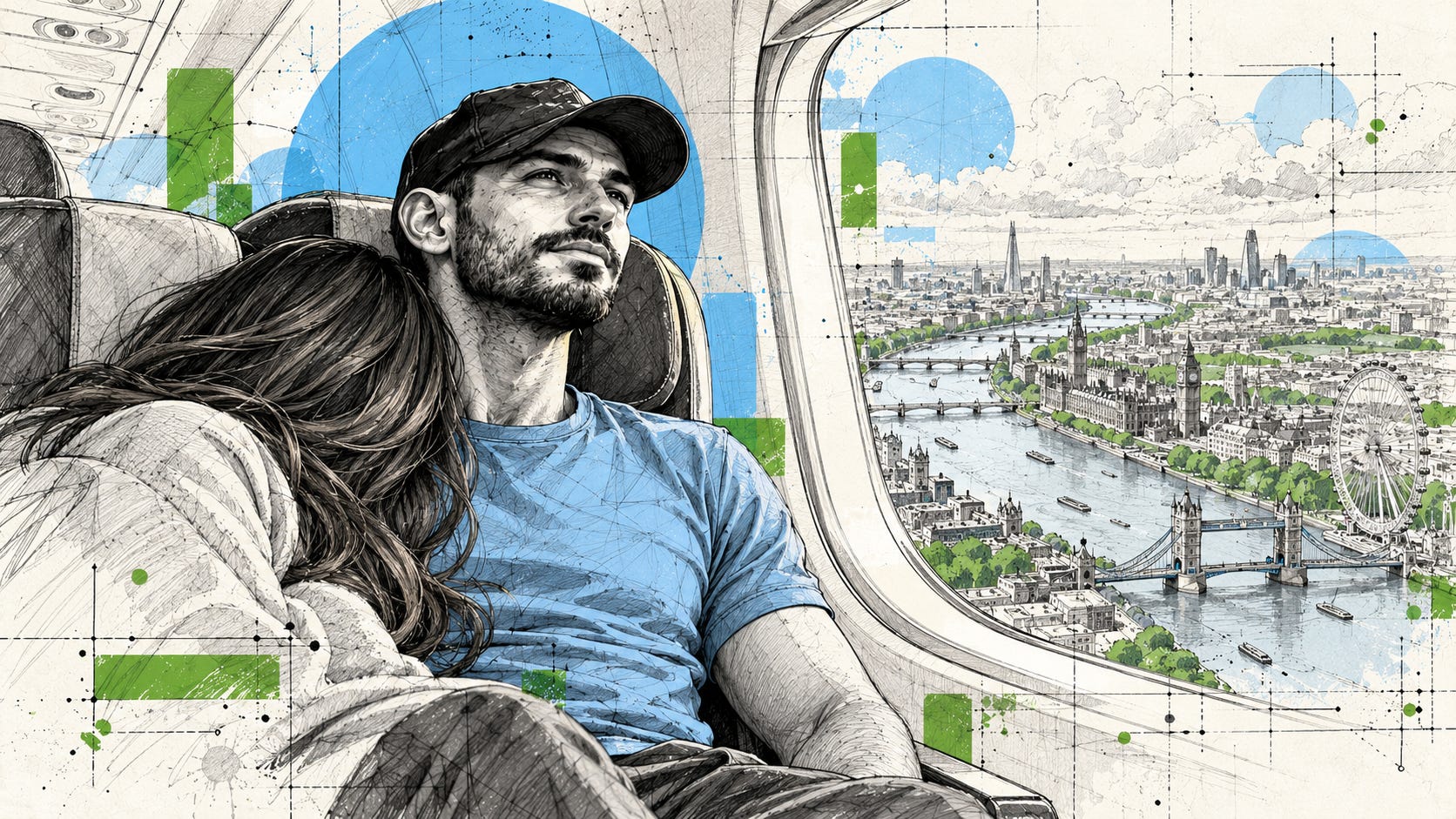
The plane climbed out of London through a thick grey cloud, shaking a little, the wing outside the window disappearing into white. And then, all at once, they broke through, and there was sun.
She fell asleep against his shoulder within minutes.
He looked out of the window. Below them the cloud lay like a field of snow, endless and bright, hiding everything. Somewhere under it was the city where he had arrived with a borrowed Nokia and one folded CV. The bus stop in Stoke Newington. The garden with three chairs. The basement kitchen. The bench in the square. The sofa in a stranger’s living room. The room where he had lain in the dark for months. All of it down there, under the white, getting smaller.
Somewhere ahead was a life he could not see yet.
He was above the clouds.
Not in the cockpit. Not in the uniform. In seat 23A, with his wife asleep against his shoulder. But above the clouds, all the same. It was closer than the boy in front of the cardboard ever thought he would get.
The phone was in aeroplane mode. Nothing could go in. Nothing could come out.
He opened a new message to his parents. And this time he did not stop.
Mum, Dad. I want to tell you some things I never told you. At school I was alone for seven years. They hurt me and I never said, because I didn’t want you to worry. When I came to London I gave 250 CVs and nobody called. A chef told me I would go back where I came from. I slept on a sofa in a stranger’s living room. I paid for a pilot course and I couldn’t finish it. When the restaurants closed I stayed in bed for months and I told you I was fine. Every time I said all ok, it was not all ok. I wrote you so many messages and I deleted all of them. I am ok now. Really ok. I just wanted you to know all of it. I love you.
He read it once, slowly, all the way to the end.
He did not delete a single word.
The plane began its descent. Down through the clouds again, the white thinning into grey, then breaking apart, and under it, at last, the ground: fields, roads, roofs, a river catching the light. The phone lay in his lap the whole way down, the message waiting on the screen. Then the wheels hit the runway, and the whole cabin shook, and she woke up and smiled at him and squeezed his hand.
He switched aeroplane mode off.
The phone searched for a moment, and found a signal.
His thumb rested over the button.
He thought of his mother answering after one ring. His father on speaker beside her, at the kitchen table, putting on his glasses. He thought of them reading it, all of it, every year of it, at once.
Everything was ok now. Really ok. What would it give them, to learn all of it today? Only the pain he had spent a lifetime keeping from them.
He did not send it.
But for the first time in his life, he did not delete it either. He saved it, every word, and kept it.
He looked out at the sky above the runway. Another plane was climbing away into the blue, drawing a long white line behind it, the kind he used to search for as a boy, with his face turned up to the sky.
Then he opened a new message.
Landed. All ok.
He sent it.
And this time, it was true.