

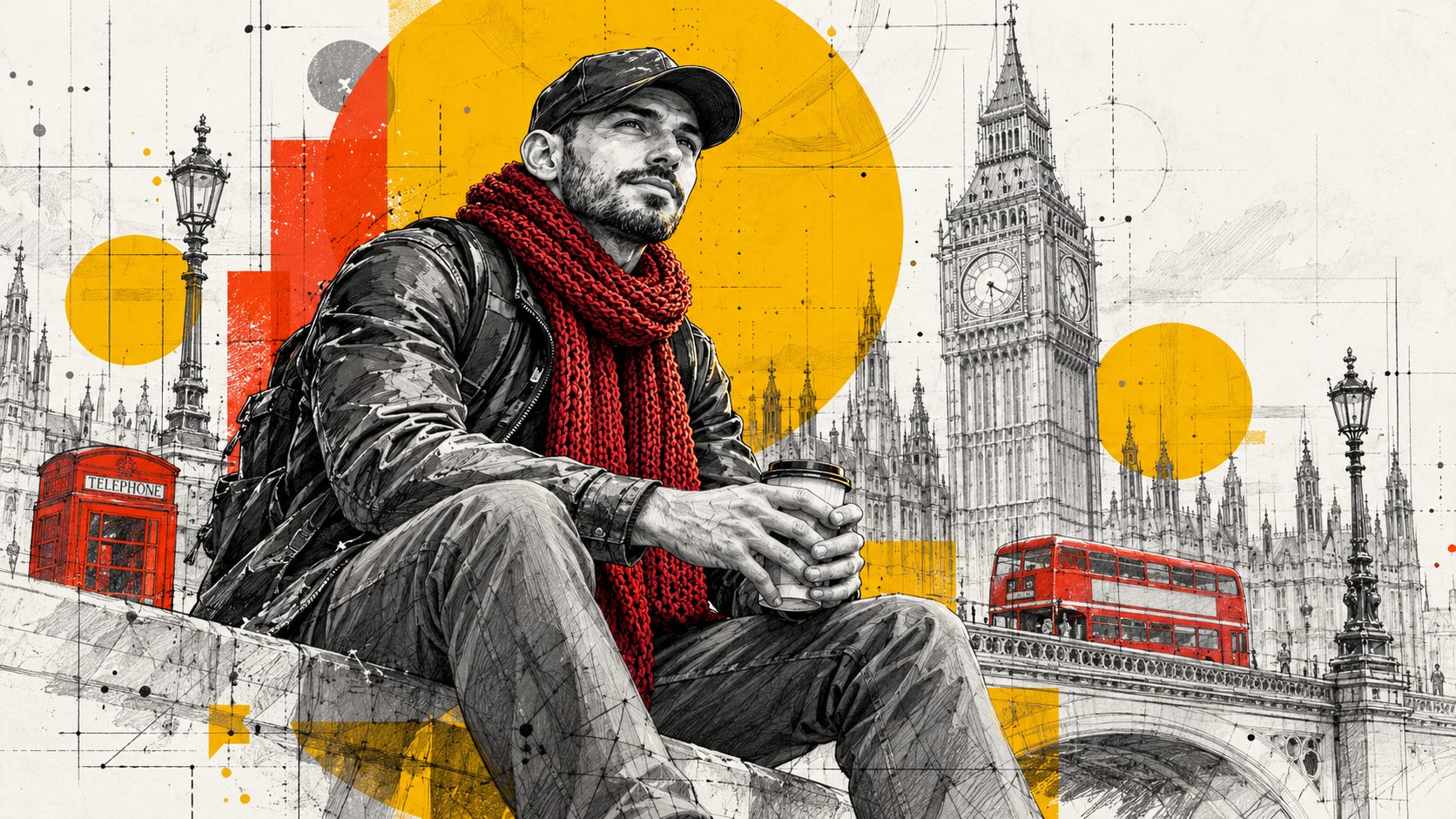
He came up out of the Underground at Tottenham Court Road with a suitcase in one hand and a folded piece of paper in the other, and London hit him all at once.
The noise came first. Engines, voices, a siren somewhere he could not see, the hiss of a bus pulling away from the kerb. Then the colour. Red buses, one behind another, so many that they no longer looked real. Black cabs sliding into gaps that were not there. And people, hundreds of them, pouring out of every door and every corner, walking fast, talking into phones, stepping around him without a glance, as if a man standing still with a suitcase was the most ordinary obstacle in the world.
He did not move. He did not want to. He wanted to stand there and take all of it in before it became normal.
At home, nothing ever moved like this. His life there could be told in four words: work, home, home, work. The same few friends in the evenings, the same café, the same conversations about the same things, until the nights blurred into one long night. He had always known he wanted more than that. He had waited longer than he wanted to. He was 26, and he had bought a one way ticket.
He was afraid. He knew nobody in this city. Not one name, not one number. But underneath the fear was something stronger, and it felt like a page being turned.
He unfolded the paper. An address on Oxford Street, written in his own hand at the desk in his bedroom, where he had found the accommodation online and studied the street on the screen until he knew every shopfront by heart.
He found it ten minutes later, and it was exactly as the map had shown him. A narrow front. A small office split between a currency exchange and a counter that repaired mobile phones. Seeing it for real gave him a strange feeling, like meeting someone he had only ever known from photographs.
Before going in, he took out his phone and typed to his parents.
All ok here. I’m good. London is massive but all ok. Will call you later in the evening.
He read it once, sent it, and pushed open the door.
The man behind the counter found his name on a list and slid a receipt across the glass with a phone number written on the back.
‘The 73,’ he said. ‘Get off at Stoke Newington. Across from the stop, call this number. Someone from the house will come for you.’
He changed some of his euros into pounds, counting the strange coloured notes twice before he put them away, and went out to find the bus.
He found it. He took it in the wrong direction.
He did not realise for a long time. He sat on the lower deck with the suitcase between his knees, watching shops go past, waiting for a name he recognised. When the bus finally stopped and everyone got off, he got off too, and found himself outside Victoria station with no idea how he had got there.
He asked a woman at the stop, holding out the receipt as if it might explain everything. She looked at it, then pointed across the road. Same number. Other side.
This time he went upstairs. He dragged the suitcase up the narrow staircase, step by step, and took the seat at the very front, right against the big window, where the whole city came towards him as if it were being shown to him on purpose.
He pressed his forehead almost to the glass. Grand buildings, then shops, then King’s Cross with its crowds, then the streets of Islington, narrower and greener, full of cafés where people sat outside despite the cold. He could not read the names fast enough. He did not know what anything was called, or what any of it meant. His English was enough to buy a coffee, and not much more.
Alone, in a city of millions, with no job and no friends and a little money in his wallet. He should have been terrified. Instead he sat at the front of that bus like a child at a window, and he had never been happier in his life.
The next stop is Stoke Newington.
He was out of his seat before the voice had finished, half carrying and half falling down the stairs, the suitcase knocking against every step.
The doors opened, and the first thing he noticed was the smell. A park beside the road. Wet grass and damp earth after rain, cool and green and nothing like the city he had just crossed. He stood on the pavement and breathed it in. Years later, he would still be able to close his eyes and find it.
He lit a cigarette, his hands not quite steady, and called the number.
From across the road came a sharp whistle. A man was waving at him, one arm high above the traffic.
‘Watch the cars! Come!’
He dropped the cigarette, stepped on it, and ran.
They walked for less than a minute. The house stood beside a small market, crates of vegetables stacked on the pavement outside: tomatoes, peppers, bunches of coriander, oranges piled in careful pyramids. The people buying them came from everywhere, every face from a different corner of the world. None of them looked English, and yet all of them spoke English perfectly, easily, without thinking about it. He listened to them while the man searched his pockets, muttered something, and rang the bell, because he had forgotten his own keys.
‘First time in London?’
‘First time away from home.’
‘You have friends here?’
‘No.’ He hesitated. ‘I bought a ticket one way. I came to see.’
The man waited, so he went on, surprising himself.
‘Since I was a kid, I told my mum, one day I go to London. I don’t know why. I always wanted it.’
The door opened. Inside it smelled of cooking and damp coats.
‘Eight of us live here,’ the man said, leading him down a narrow hall. ‘All students. The house is only for students.’ He glanced back. ‘You’re studying, yes? Or just here for a week?’
Nobody had told him that. Not on the website, not at the office, not anywhere. He felt the floor shift a little under his feet.
‘No, no. I will study. I will study…’ His mind went completely blank. He grabbed the first thing he could find. ‘English. I need to learn English.’
‘Good.’ The man seemed satisfied. ‘The landlord comes next week. Better you have a paper from the school by then.’
In the kitchen, two young Germans were having dinner at the table. They told him cheerfully that they were here for two months to learn English, and then going home. Another boy came out of a room with a towel over his shoulder; he was leaving in three days, and someone new was already coming for his bed. It was a house of people arriving and leaving. More a station than a home.
And him in the middle of it, with no school, no paper, and one week.
The first fear of London arrived quietly, and sat down beside him.
The bedroom had four beds, so close together there was barely room to walk between them. A jacket on one, a pile of books on another, an open suitcase on the third.
‘This one’s yours. You share with three. One bathroom, upstairs. In the morning it’s busy, so better you wake up early.’ The man yawned. ‘I’m going to my room. Nice to meet you. See you tomorrow.’
‘Thank you,’ he said. ‘Thank you for everything.’
And then he was alone in the corridor, between the four beds and the closed doors, not sure where to put himself.
He found his way back through the kitchen and out into the garden. It was small and neglected: a cracked patio, weeds pushing up between the stones, a table with three chairs that did not match. He sat down and took out the phone.
He began to type. About the room with four beds. About sharing it with three strangers. About the paper he did not have, the school he had invented in a panic on the doorstep, the landlord arriving in a week who might put him straight back out on the street.
He looked at the words for a long time.
Then he deleted them, and called instead.
It rang once.
‘I’ve been waiting for this call all day,’ his mum said, and he could hear that it was true. ‘You’re on speaker. Your dad is here.’
‘So?’ said his dad. ‘How was everything? The flight? The journey?’
‘All good, Dad. I arrived at the house a few minutes ago. London is massive. I met new friends already. All ok.’
‘And tomorrow?’ his mum asked. ‘What is the plan?’
‘Tomorrow I go back to the office where I got the address. To ask some things, you know, in general. Then I start looking for a job.’ He watched a light come on in a window above the wall. ‘London is massive, Mum. In a few days I’ll be settled.’
His credit was running out. He told them he needed an English SIM card, that he would call again soon.
‘Ok, son. Update us.’
‘Love you both. Say hi to my brother.’
When the call ended, the garden was very quiet. He lit another cigarette and listened to the city on the other side of the wall. Sirens rising and falling. Buses sighing at the stop. Footsteps, laughter, someone shouting a name. A whole world he could hear but not yet see. He could not wait for the morning.
When he went back inside, the house had gone dark. The kitchen was empty. The living room was empty. He opened the bedroom door slowly and found three shapes already asleep. As quietly as he could, he opened his suitcase, found a towel, showered, and lay down on the bed that was now his.
He did not sleep. He lay listening to three strangers breathing and the city humming outside, his mind running in circles: the landlord, the school, the money, the job. Some time after five, he finally drifted off. At seven, the house woke up around him. The kettle. Voices in the kitchen. A queue outside the bathroom door. Good morning, good morning, and nothing more, because everybody was already late for something.
He made a cup of tea, took it out to the garden, and waited until every one of them had gone.
The bus stop was packed. When the bus came, he was carried on with the crowd and pressed against a window, his cheek almost touching the glass. Nobody spoke. Everyone had headphones in, or stared at a screen, or stared at nothing. Strangers on their way to work, standing closer to each other than lovers, never once looking at each other’s faces. Every two minutes the bus stopped, and some got off, and more got on.
He had studied the Tube map half the night, a free one he had taken from the station, and now he knew the way: off at Finsbury Park, then the Victoria line south to Oxford Circus. On the platform a warm wind rushed out of the tunnel before the train, and he felt as if he had walked into one of the films he had grown up watching.
Everyone on the train held a smartphone. Music, videos, messages, every face lit by its own small screen. His phone stayed in his pocket. It was an old Nokia with a green screen, borrowed from a friend, because his own smartphone had broken a few days before he left. Among all that bright glass it looked like something from a museum, and he kept his hand over it so nobody would see.
At Oxford Circus he climbed up into a rain so fine it was more like dust. He bought a coffee and sat by the window, watching the city go about its morning, and he enjoyed every second. Then he took the coffee and walked down Regent Street, between buildings so grand that he kept stopping to look up at them, until he reached Piccadilly Circus.
He stood in the middle of it. The giant screens. The buses. Hundreds of people every minute, every colour, every language, all of them rushing to catch something or to reach somewhere.
All these people, he thought. They came from the other side of the world, and they found work here. If they can do it, so can I.
He bought a sandwich and a bottle of water and nearly laughed at the price. At home, that money was a whole lunch, with a coffee after.
At the exchange shop they remembered him and offered him a cup of tea.
‘I’m looking for a job,’ he said, holding the cup in both hands. ‘Any job. Kitchen, cleaning, handyman. Something without perfect English, until I learn. If you hear of anything, please.’
‘Ok,’ they said. ‘We’ll let you know.’
He took the 73 home, upstairs, front seat. The Tube would have been faster. But he wanted the view.
That night he borrowed a laptop from one of the students and made his first ever Facebook account, for one reason only: to join a group of Europeans looking for work in London. He scrolled through post after post. Pubs, restaurants, cafés, hotels. And under every single one, the same advice. Don’t send emails. Nobody reads them. Print your CV and walk in. They have to see your face.
He had one CV. He had printed it at home before he left, and it had crossed Europe folded in his suitcase, and now it was soft at the creases.
‘Come with me in the morning,’ said one of his flatmates. ‘There’s a shop next to my college. With my student card, it’s five pounds for fifty copies.’
It was a strange little shop, the kind where nobody could have said exactly what the business was. A printer humming in the corner. Cards in the window for rooms to rent. Posters for cheap flights. Crisps and chocolate beside the till. He printed fifty copies, still warm from the machine, and went straight to Oxford Street.
He walked into everything. Restaurants, clothes shops, cafés, bookshops, anywhere with a door and a person behind a counter. Fifty CVs were gone in thirty minutes.
The next day he went back alone and printed two hundred more. He packed them into his backpack and walked from ten in the morning until four in the afternoon, door after door after door, until his feet ached and his smile felt stiff on his face. Every few minutes he took out the Nokia and checked the green screen.
Nothing.
The day after, he gave away the rest.
Three days. Two hundred and fifty CVs. Not one call.
The money was leaving faster than he had imagined. The rent. The Oyster card. The sandwiches that cost a lunch. Every night he counted the notes in his wallet, and every night there were fewer, and every night he did the same sum in his head and arrived at the same answer. Not long.
He sat in a café near Oxford Street, ordered the cheapest thing on the menu, and began to type to his mum.
Hi mum, hope everyone is well. I’m good. Trying to find a job but it seems a bit difficult. I’m trying but I’m a little scared. Life is expensive here and I’m keeping the costs low. I kept some money aside, if I don’t find something I have money for the ticket back. But all good, don’t worry.
His thumb hovered over the button.
He pictured her reading it. In the kitchen, with her glasses on. He pictured her face as she reached the word scared, and his dad leaning over her shoulder, and the two of them sitting there afterwards in the silence, so far away, unable to do anything at all.
No need to make them worry, he thought. It’s only been a few days. Everything will be ok.
He held down the clear key and watched the words disappear, one letter at a time, until the screen was green and empty again.
Later, near Bond Street, he sat outside a café with a coffee and a cigarette. When the waiter put down the cup, he asked him.
‘Do you need anyone here? For the kitchen, or any job?’
‘Not right now, mate.’ The waiter shook his head, not unkindly. ‘Try the big restaurants. Christmas is coming. They always need people at Christmas. You’ll find something for sure.’
He was worried. But underneath the worry there was something else, something he could not explain: a strange, stubborn calm, a feeling that he would be ok. He wanted to call home. He wanted to hear their voices. But they would hear his too, and they would know.
So he typed instead.
All ok, I’m ok. Enjoying a coffee. Will call you soon.
That one, he sent.
Some people would think it was nothing. People who had travelled all their lives, who moved countries the way others moved flats. But for him it was everything. He had come here to start from zero: a little English, a little money, no help, no friends. Alone in a rainy capital, looking for one door to open.
The next morning, the phone rang.
It was the man from the exchange shop.
‘There’s a restaurant in Soho. They need someone in the kitchen, a junior, to help with the prep. Come to the office at three. At four, you go and meet the chef.’
He said yes three times before the man had finished speaking.
He made breakfast and a coffee and carried them out to the table in the garden, and he could not stop smiling. A job. His first job in London. He took out the phone and began to type.
Mum, I have news
He stopped.
Let me get the job first, he thought. Then I’ll call them. Then I’ll tell them everything at once.
He looked at those four words for a long time. Then he held down the key until they were gone, and put the phone face down on the table.
The buses went past on the other side of the wall, one after another, the way they had on his first night. But they sounded different now. For the first time since he had come up the steps at Tottenham Court Road, the city did not sound like something he had to survive. It sounded like something that had been waiting for him.
⁂
Next, in Part Two: a basement kitchen in Soho, and a chef who wants him gone before the first hour is over. A restaurant behind dark windows, a no, and a reason to go back anyway. A man at the job centre who hears about a boy, a cardboard cockpit, and a dream that costs more than he will ever earn. The messages keep coming. He keeps deleting them.