

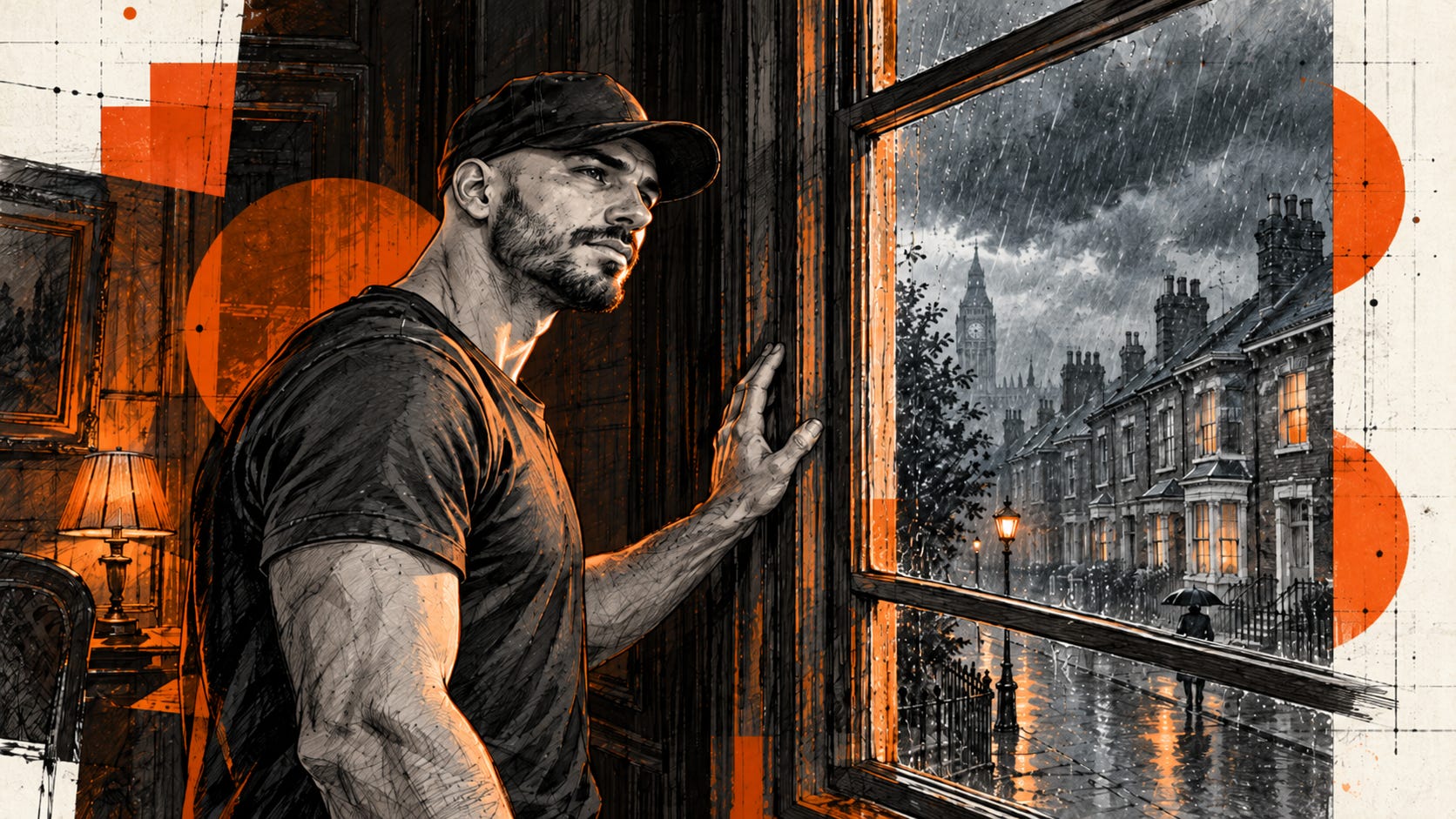
In Part Two, he walked out of a basement kitchen, begged his way through a door behind dark windows, and learned what a runner was. He told a man at the job centre he would become a pilot, and later put the dream in a drawer. He rose from carrying plates to running the numbers. At home, his mother asked if he had struggled, and he said no. And when his colleagues shut him out, he remembered the silent boy at the back of the classroom, who never told anyone anything.
⁂
The knock came early, before seven, hard and official, the kind of knock that does not wait to be answered.
He opened the door in a T shirt, half asleep. Two officers from the council stood in the corridor with folders under their arms. They were polite. They were sorry. The flat belonged to the council, they said, and the man who had rented it to them had no right to do so. Everyone living there had to leave. Immediately.
‘But I didn’t know,’ he said. ‘Nobody told us. I’ve lived here almost two years.’
One of them looked at his folder. The other looked past him, into the flat, at the coats on the hooks and the shoes in a row by the door.
It made no difference.
He woke his flatmates and told them, standing in the kitchen in the grey light, and watched the same thing happen on each face: the confusion, then the sum. Where. How. When. Then he got dressed and went to work, because there was nothing else to do, and all day, between tables, he asked everyone he could. A spare room. A sofa. Anything, for a few weeks.
Nobody had anything.
On his break he sat on an upturned crate by the back door, among the bins and the smokers, and typed.
Hi dad, all good here. I’m moving to a new place, the council came this morning and
He stopped. He pictured his father reading it at the kitchen table, putting on his glasses, reading it again.
He deleted it.
It was late in the evening, after service, when one of the managers stopped him by the stairs.
‘I heard about your flat. Listen. I have a living room with a sofa bed. It’s me, my wife and my son, and we don’t really use that room. You can stay a few months, until you find something.’
He could have hugged him. He shook his hand instead, twice, and said thank you so many times that the manager laughed and told him to stop.
The next day he carried everything he owned down nineteen floors and loaded it into a black cab. One suitcase. One backpack. A few bags. Nearly two years in London, and it all fitted in the back of a taxi.
The sofa bed was in the corner of a small, warm living room full of someone else’s life. Family photographs on the shelves. A child’s drawings stuck to the fridge in the kitchen next door. A television he did not touch. At night he unfolded the bed as quietly as he could and lay listening to the sounds of a family behind the walls: a mother’s voice, a boy laughing, a door closing softly. In the morning he folded it all away again before anyone woke, so that the room would look as if he had never been there.
As a boy he had dreamed of London. Now he was a guest on a sofa in somebody else’s family.
Just to let you know I moved to a new home. Few issues with the previous house but all ok now. Hope you are well.
That one, he sent.
Some months later, a new restaurant was opening two streets away, and they called him.
They had heard about him, they said. They wanted someone like him from the start. Better conditions. A real title. A manager, or a supervisor at the very least. They said all of it on the phone, warmly, as if it were already decided.
When he resigned, his managers asked him to stay. They offered him more money, more responsibility, a better title of their own. He thanked them. He meant it. But he had already decided. He had been in the same place for years, and he needed something new.
He texted home that night, from the sofa bed, in the dark.
New job, new chapter. I start in a few days, tomorrow I have the final meeting at the office.
He sent that too.
The head office was all glass and pale wood, very quiet. He gave his name at the desk and sat down to wait, his best shirt ironed, his CV in a folder on his knees.
There was a pause when they called him in. Papers moved from one side of the desk to the other. Somebody checked a screen.
‘There may have been a misunderstanding,’ the woman said at last. ‘The only position we have available is runner.’
Everything went dark.
For a moment he did not understand the word. Then he understood it too well.
‘But they told me manager,’ he said. ‘Or supervisor at least. I spoke to them. They told me. Not runner.’
‘I’m sorry. There’s nothing we can do. That is the position.’
He sat very still. He had already resigned. His old job was gone; somebody else was probably already doing it. He was sleeping on a sofa in another man’s living room. He had nowhere to go back to.
So he signed. For half of what he had been earning the week before. He told himself, holding the pen, that once they saw what he could do, they would promote him straight away. It would be a few weeks. A month at the most.
Outside, on the pavement, he took out the phone.
Hi mum, I made a mistake. I shouldn’t have left the old job
He looked at it. He could hear exactly how she would say his name when she read it.
Why make them sad, he thought.
He deleted it and went home to the sofa.
On his first night, he found out that some of his old colleagues had joined the new restaurant too. They had applied before him. Now they walked the floor in dark suits, with earpieces and clipboards, greeting guests at the door. And he stood at the pass in an apron with a tray in his hands, waiting for a table number, doing exactly what he had done on his very first Friday in London, years before.
One of them caught his eye across the room and looked away.
It did not take long for someone to notice him. The head of department passed him on the stairs one afternoon, stopped, and asked him into the office. They talked for an hour: about the numbers, the systems, everything he had built at the old place. She listened. Soon he was helping the finance department. Then with more. Then with decisions.
In the mornings, he sat in meetings where the future of the business was discussed, in his own clothes, a laptop open in front of him. In the evenings, he changed into his apron and carried plates.
Not everyone liked that.
His shifts began to change the day before, then the evening before, then an hour before. He was given tasks that were not his to do. Small things, every week. None of them big enough to complain about. All of them together enough to wear a person down.
One night, on the sofa bed, he wrote a long email to the head of department and the directors. He explained everything, carefully and politely: the schedule, the changes, how impossible it was becoming to do both jobs. He read it four times. His finger was on the button.
He deleted it.
The next morning he asked to see the director in person, and he sat across the desk from him and said it, all of it, calmly, to his face. It was the first time in his life he had chosen to say a hard thing out loud instead of swallowing it.
A year after he had signed for half his salary, they made him assistant manager. By then, most of the people who had made his life difficult were no longer there.
In the afternoons, between the meetings and the service, he bought a coffee to take away and walked to a square nearby, and sat on the same bench every day.
Above him, the sky was full of white lines.
They crossed and recrossed each other, some sharp and new, some already softening and spreading into nothing. Lower down, the planes came in one after another over the roofs, wheels down, turning slowly towards one of the airports that ringed the city. He could still tell most of them apart by their shape. He had never lost that.
Every time he looked up, he felt it. Not regret, exactly. Something older and quieter than regret. The cardboard cockpit in the corner of a boy’s room. The buttons drawn in marker. The windows cut out by hand, so the wall behind them could be the sky.
He did not regret anything. He told himself that on the bench, often. He had a career now, a real one. He wanted to move into operations, to lead the business one day, and later to advise other businesses with everything he had learned about numbers and service and people. All of that was real, and all of it was his.
But the planes kept coming, every afternoon, one after another, and he kept looking up.
He moved again. When the months on the sofa had run out, he found a studio in a family house in the north of the city, one small room with a kettle and a single window. The area never felt right. Shouting in the street at night. Sirens that stopped close by. He stayed almost a year, sleeping lightly, and never once said a word about it when he called home.
Then his closest colleague told him there was a room free in the house where he lived, in the south, in Streatham. Better street. Better light. People he could trust. He moved again, the same suitcase, the same backpack.
All ok.
Home, work. Work, home. The same rhythm as his first years, only now with keys to his own room. Years of it, until he could no longer say which year was which. On his days off, he did not go to bars or parties. He went to the theatre alone, to libraries, to sit somewhere quiet with a book. Now and then he bought a ticket to an aviation conference or an air show, and stood at the back of the hall and listened to people who flew for a living, the way he had once stood at the edge of the pilots’ circle.
Then, one morning, one of the flatmates gave notice on his room.
‘A friend of mine is coming from abroad,’ he said. ‘She needs somewhere to stay. Is that ok with everyone?’
They said yes.
A few days later she arrived, with one big suitcase and the tired, wide open face of someone who had just come up out of the Underground into a city that was too big for her. He knew that face. He had worn it.
She had come for good. To learn English. To work. And one day, she said, to fly. As cabin crew. Above the clouds.
To fly.
He looked at her when she said it, and for a moment he did not say anything at all.
He found her a job as a runner in his restaurant, and on her first day he showed her the table numbers himself, both floors, the way the head waitress had once shown him. He gave her some of his books. ‘Read them,’ he said. ‘Slowly. With a dictionary. They’ll help your English.’ She read them all.
At work, the same struggles came round every few months like weather. New directors arriving. Changes from above. New people placed in high positions, and everything he and his colleagues had built quietly set aside, as if it had never been there. He was tired in a way he could not explain to anyone. Sometimes, on the bench, he thought about New York, the other city he had dreamed of since he was a boy. London he had done. He had wanted more than this.
He still called home often. Short calls, easy ones. How are you, how is Dad, all ok here. He almost never texted any more.
He knew why. A text gave him time. Time to find the words, and the words were always true. A call was over before the truth could catch up with it.
In the kitchen of that house in the south, late at night, after the others had gone to bed, he and the girl began to talk. Over tea. About leaving home. About starting from nothing. About the first months, the fear, the money in the wallet getting thinner. About wanting, both of them, since they were children, to be above the clouds.
She told him things she had never told anyone. And he found, to his surprise, that he told her some things too.
Neither of them meant for anything to happen.
Something did.
One night, walking back to his room, he took out the phone and opened a message to his parents. He wanted to tell them. That there was someone. That for the first time in all these years in London, he did not feel alone.
He looked at the empty screen for a long time.
Too early, he thought. Let me be sure first.
He put the phone away.
⁂
Next, in Part Four, the final part: the year the whole world stopped, and the room he could not leave. The message that was hardest of all to write. A photograph sent home before anything was certain. A bakery window, a small wedding, and a plane climbing out of London above the clouds, at last.